Waza Kotoba
Learn the words behind judo and junomichi techniques.
5 iterations 22 September 2026
Play Waza KotobaBest on a phone, portrait. Opens full screen; use your browser's back button to return.
The prompt
Waza means technique, kotoba means word. A quiz, not an arcade game, and in French: I made it for a small junomichi club in Brittany, where beginners — and the parents on the bench — hear o-soto-gari or sasae-tsuri-komi-ashi for years without ever being told what the words mean.
I did not believe it was doable. Roughly what I asked, from memory:
Can you imagine a game to understand the fundamentals of judo/junomichi? Basic Japanese, technique names, katas, pictures of the techniques… I’m asking, but I don’t have much faith in what’s feasible.
The answer reframed the whole thing: technique names are Lego bricks. About thirty Japanese words — o is big, soto is outside, gari is reaping — will decode sixty techniques. So the first mode was simply: here is the meaning, assemble the name from tiles.
The iterations
- The core. Three modes — assemble the name, translate it, sort it into its family — plus a lexicon. No pictures, on purpose.
- Nage-no-kata. The fifteen throws, put back in order, series by series.
- Katame-no-kata and ju-no-kata. Same mechanic, thirty more techniques, and a vocabulary grown to sixty-six bricks.
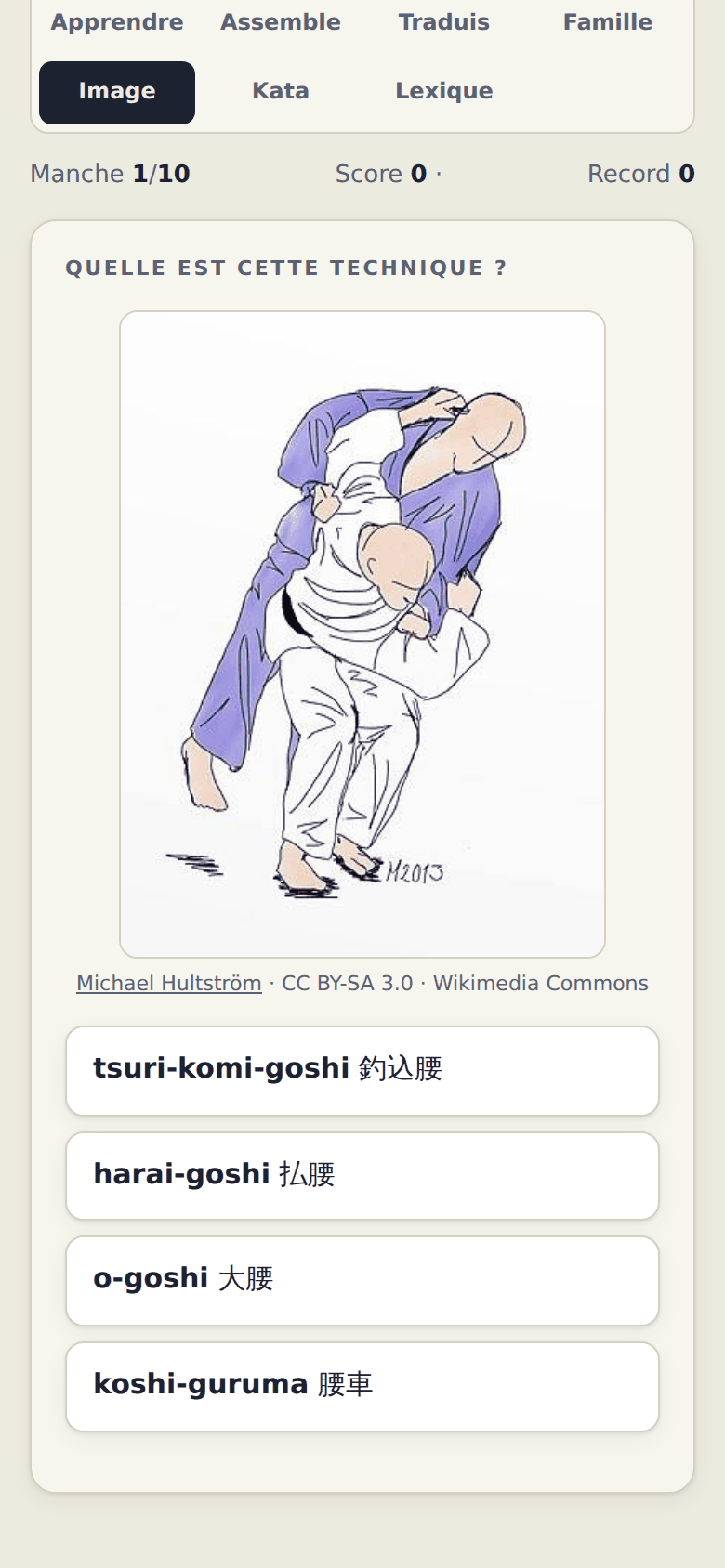
- Pictures. The part I thought was impossible. A 1915 manual I hoped to use is not freely scanned anywhere, so we took a set of illustrations from Wikimedia Commons instead, all drawn by one person, under a free licence: 43 techniques out of 63 have a drawing, credited under it.
- A study mode. I wanted to learn before being tested. One card per technique: the drawing, the name, the kanji, each brick explained, and where it sits in the katas.
What I learned
The hard part was never the code, it was the terminology: the same syllable can be two different words — kata is a shoulder or “one side” depending on the kanji — and koshi becomes goshi by a sound rule, not because it is another technique. The game explains both, and the club’s teachers still have the final say. The kanji font, the indigo and vermilion, the tatami background: all chosen in the first exchange, never touched again.
Illustrations: Michael Hultström (CC BY-SA), diagrams by Judcosta (CC BY-SA), kata photos from the Edmonton International Judo Championship (public domain), via Wikimedia Commons.